
Professional Clutch & Brake Manufacturer— High-tech Enterprise、Source Factory—
-
 Chinese
-
+86 13929211567
Professional Clutch & Brake Manufacturer— High-tech Enterprise、Source Factory—
Chinese
+86 13929211567
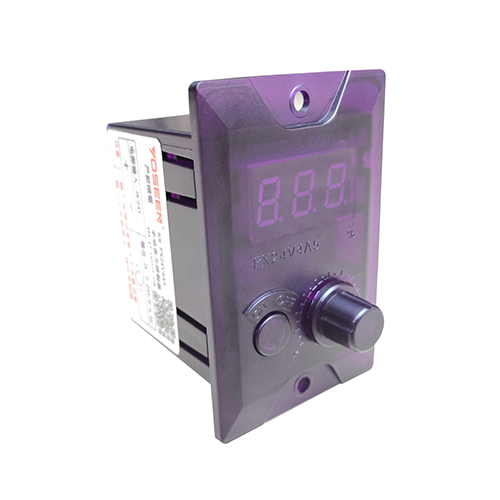
A tension controller is a device that utilizes the force exerted by a magnetic field on a moving conductor to generate vibration damping.
Tension Controller
Do you know what common faults occur on tension controllers?
1. Faults of the controller main unit
No display on screen, the whole unit fails to power on
220V/24V power supply cut off, blown fuse, damaged switching power supply;
Short circuit on internal mainboard, loose power cord, oxidized terminals with poor contact.
Screen lights up, but parameter buttons fail to work and touch panel does not respond
Aging membrane keypad, loose touch screen cable;
Single-chip microcomputer failure on mainboard, program freeze which cannot be recovered after restart.
Fluctuating readings, drifting tension display, inaccurate zero reset
Damaged signal amplification circuit on mainboard;
Faulty internal AD acquisition module, unable to stably receive sensor signals.
No output current, magnetic powder produces no resistance at all
Burnt excitation output module of the controller;
Breakdown of output power transistor, no DC 0-24V excitation voltage output.
Uncontrollable output current, unable to reduce full torque
Breakdown of mainboard control loop leading to continuous maximum output current;
Damaged PID chip, ineffective adjusting knob / analog signal.
Abnormal alarms: false triggering of material break alarm and overload alarm
Faulty detection circuit on mainboard, disordered threshold logic;
Lost program, garbled parameters.
Communication failure (RS485/Modbus fails to connect PLC)
Damaged 485 chip, incorrect address / baud rate parameters;
Burnt communication port, unable to upload tension data or download formulas.
2. Tension sensor feedback faults
Severely fluctuating tension readings with continuous oscillation
Tension roller stuck by adhesive and accumulated dust;
Deviated sensor stress position, loose mounting bracket;
Fatigue deformation of sensor elastic body.
Tension reading remains zero, no feedback signal at all
Broken sensor signal wire, water ingress and oxidation of aviation plug;
Damaged strain gauge, complete sensor failure.
Readings exist under no load, severe zero drift
Zero point not calibrated regularly;
Unshielded signal cables, interference from frequency converter;
Plastic deformation of elastic body caused by long-term sensor overload.
Tension readings higher or lower than actual, displayed tension inconsistent with real pulling force
Wrong sensor measuring range selected;
Lost signal gain parameters;
Unilateral stress applied on the sensor.
Readings jump with slight vibration
Damaged shielded cable, interference from parallel routing of strong and weak current wires.
3. Actuator faults
Tension remains unchanged no matter adjusting the controller
Broken excitation coil of magnetic powder unit;
Magnetic powder leakage, no magnetic powder inside so damping torque cannot be generated.
Irregular tension, web jitter and wrinkling
Magnetic powder agglomeration and uneven distribution leading to unstable torque output;
Locked magnetic powder bearing causing fluctuating rotational resistance.
Magnetic powder overheats severely and emits smoke
Long-term excessive output current from controller;
Aging magnetic powder slips and generates heat by friction; blocked heat dissipation air duct.
Unable to release after shutdown, web cannot be pulled
Short-circuited excitation coil, continuously energized to output torque.
Stable tension at low speed, slipping and web breakage at high speed
Insufficient magnetic powder, maximum torque fails to meet equipment requirements.
4. General faults caused by wiring, connection and interference
Tension jumps sharply once acceleration starts
Signal cables laid together with motor power cables, strong electromagnetic interference from frequency converter; no twisted shielded cable used or shield not single-end grounded.
Intermittent malfunction triggered by equipment vibration
Loose terminals, water-corroded plugs, hidden wire breakage inside cables.
Frequent faults on humid rainy days
Short circuit and signal leakage caused by water ingress in control cabinet and sensor plugs.
Failure of external 0-10V/4-20mA setpoint signal
Damaged analog control wire, faulty PLC output module.
5. Pseudo-faults induced by mechanical matching
Web tension fluctuates and cannot be stabilized no matter adjusting controller parameters
Locked bearings of guide roller and traction roller; eccentric material roll, uneven web thickness; failed damping spring of dancer roller.
Inner layer wrinkling during winding
Not controller damage; taper tension function not activated or taper parameter set too small.
Frequent web breakage
Excessive mechanical resistance, film cut by burrs on roller surface, not tension control failure.
Inaccurate roll diameter calculation and continuous tension attenuation on semi-automatic models
Dirty encoder / ultrasonic roll diameter measuring probe, offset installation.
6. Faults from control program and parameter setting
Improper PID parameters: Overlarge proportional P value → oscillation; too small P value → slow tension response.
Incorrect settings of material break threshold and upper/lower tension alarm parameters leading to false alarms.
Taper tension not activated, resulting in material wrinkling on large rolls.
Lost sets of formula parameters causing abnormal tension after material switching.
Too short acceleration/deceleration buffer time, sudden tension change during start and stop leading to web breakage.

Factory Area 1: No.1 Wusong Third Street, Yuwu Industrial Zone, Dongcheng Street, Dongguan City, Guangdong Province
Second Factory Area: No.1 Wusong Second Street, Yuwu Industrial Zone, Dongcheng Street, Dongguan City, Guangdong Province