
Professional Clutch & Brake Manufacturer— High-tech Enterprise、Source Factory—

-
 Chinese
-
+86 13929211567
Professional Clutch & Brake Manufacturer— High-tech Enterprise、Source Factory—
Chinese
+86 13929211567
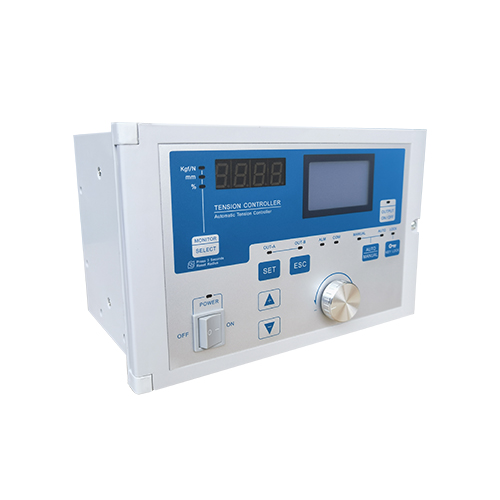
Here are the common faults of tension controllers:
1. Unstable and fluctuating tension
Fluctuating tension causes wrinkling, stretching and uneven winding. Main causes include loose or offset sensors, stuck roller bearings, mismatched PID parameters, incorrect roll diameter calculation and poor signal contact. Solutions: fix and calibrate sensors and guide rollers, lubricate bearings, adjust PID values, recalibrate roll diameter, fasten terminals and ground shielded cables.
High-speed tension drift with normal low-speed operation is caused by mechanical resonance, insufficient dancer damping, improper response setting and delayed magnetic powder or servo response. Solutions: increase damping, reduce response sensitivity and replace aging magnetic powder brakes.
2. Abnormal display and inaccurate readings
Black or blank screen results from power failure, blown fuse, loose wires or damaged panels. Solutions: check voltage, replace fuse, reconnect wires or replace the panel.
Zero tension reading is caused by broken sensors, damaged signal lines or faulty controller channels. Solutions: test sensor signals and replace damaged parts.
Locked full-scale or irreducible tension values are caused by sensor jamming, zero drift, signal short circuit and abnormal installation preload. Solutions: reset and calibrate sensors, troubleshoot short circuits and adjust roller position.
Jumping and garbled data are caused by electromagnetic interference and ungrounded shielding. Solutions: separate signal cables from power lines, apply single-end grounding and install anti-interference magnetic rings.
3. Abnormal output and actuator failure
For magnetic powder brakes and clutches: no braking force is caused by zero controller output, broken circuits, exhausted magnetic powder or burnt coils. Excessive non-adjustable tension is caused by faulty drive modules and agglomerated magnetic powder. Sudden start-stop impact and web breakage are due to missing buffer and ramp parameters.
For frequency converters and servo systems: unchanged motor speed and torque result from faulty analog output, disconnected communication and mismatched slave parameters.
4. Alarm errors
Sensor alarms are triggered by out-of-range signals, open or short circuits. Overload alarms are caused by mechanical jamming and shorted drive modules. Abnormal roll diameter alarms come from loose or faulty encoders. Corresponding calibration, wiring inspection and mechanical maintenance are required.
5. Functional faults
Invalid taper tension is caused by disabled taper function, wrong coefficient and failed roll diameter detection. Auto mode failure is due to incorrect switch setting, disconnected sensors and missing enable signals. Unsaved parameters are caused by dead backup batteries and mainboard faults.
6. General troubleshooting steps
Check power supply, switches and fuses; inspect wiring, terminals and grounding; eliminate mechanical jamming and looseness; perform zero calibration and factory reset; confirm fault sources among controller, sensor, actuator and circuit.

Factory Area 1: No.1 Wusong Third Street, Yuwu Industrial Zone, Dongcheng Street, Dongguan City, Guangdong Province
Second Factory Area: No.1 Wusong Second Street, Yuwu Industrial Zone, Dongcheng Street, Dongguan City, Guangdong Province